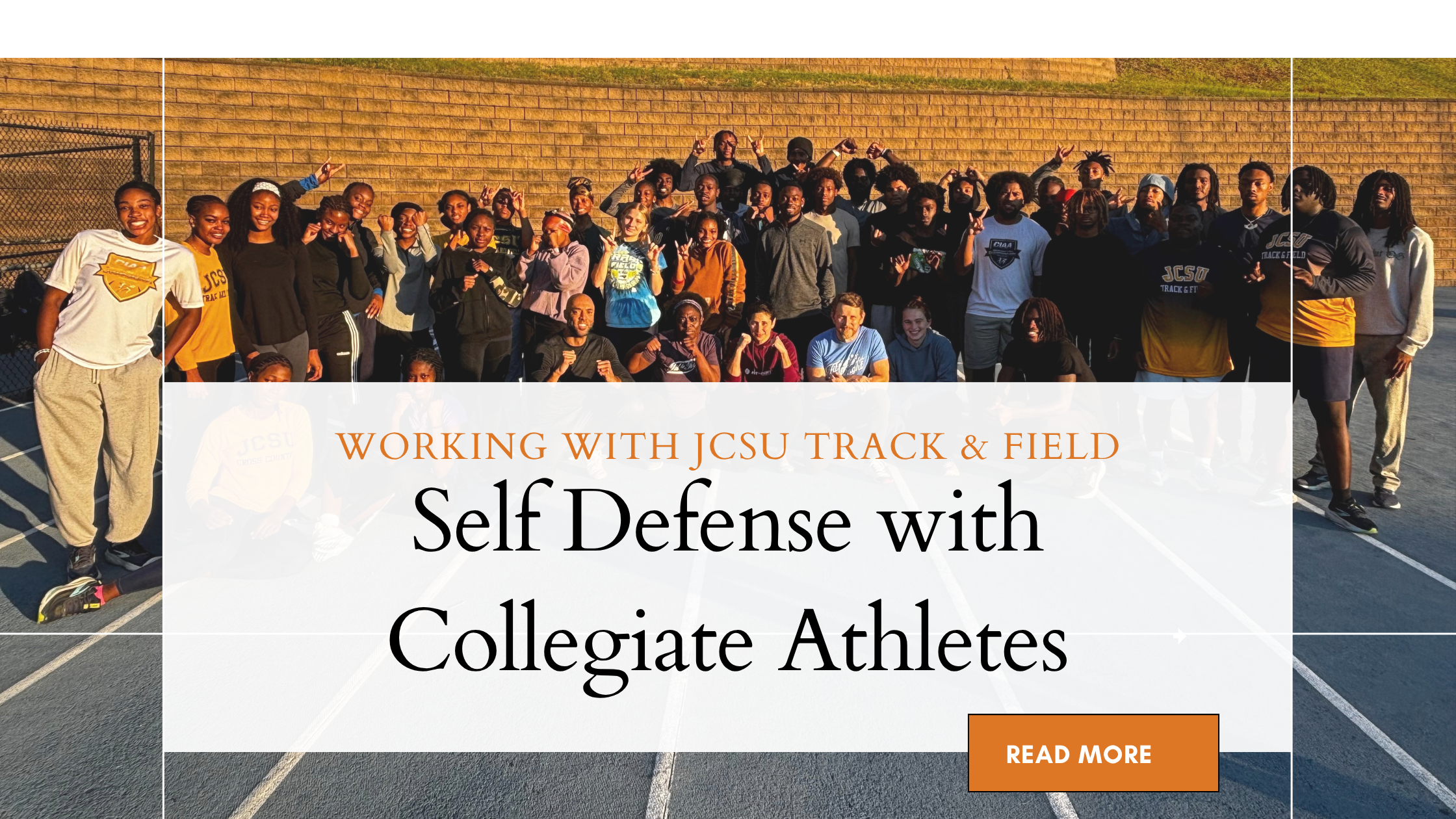
Self-Defense Training for College Athletes: Working with JCSU Track & Field.
Recently, I had the opportunity to work with members of the Johnson C. Smith University track and field teams for a self-defense training session.
There’s an obvious advantage to working with athletes.
They know how to move. They understand coaching. They’re accustomed to learning physical skills, working through discomfort, and being asked to perform with intention.
But that doesn’t mean you can simply take a standard self-defense class, put athletes in it, and expect the training to work.
In some ways, coaching athletes requires even more awareness of the environment, the population, and the purpose of the session.
Athletic ability is only a starting point
A room full of college athletes gives you a tremendous physical foundation.
They’re coordinated. They’re competitive. They often learn movement quickly.
That can make it tempting to push harder, move faster, or make the training more physically demanding simply because they can handle it.
But being capable of doing more doesn’t always mean doing more is the right choice.
These athletes have another priority: their sport.
My job during a self-defense workshop isn’t to prove how difficult I can make the training. It’s to give them useful skills and experiences without unnecessarily increasing the risk of an injury that affects practice, competition, or their season.
That matters in any athletic environment, but it became particularly relevant here because we were working outside on a cement track.
Good coaching means recognizing those constraints and adjusting accordingly.
Self Defense has to fit the person in front of you
One of the biggest mistakes in self-defense training is treating the curriculum as more important than the student.
The techniques might stay similar from group to group, but the way you teach them shouldn’t.
College athletes have different concerns, environments, experiences, and physical abilities than a group of elementary-school students, working professionals, or older adults.
For college students, relevance matters.
They’re moving around campus. They’re traveling. They’re going to parties. They’re interacting with people they know and people they don’t. They’re navigating social relationships where the situation is rarely as simple as, “A stranger attacks you in a parking lot.”
So the training has to reflect that.
We can work on physical skills while also discussing awareness, decision-making, boundaries, distance, communication, and recognizing when a situation is changing.
The physical part matters.
But the ability to recognize a problem early and make a good decision matters more.
Athleticism can help... or get in the way
Athletes are used to solving problems athletically.
Move faster. Be stronger. Push harder. Win the exchange.
That mindset is incredibly valuable in sport.
Self-defense introduces a different question:
What is the safest and most efficient way out of this problem?
Sometimes that means using athleticism.
Sometimes it means slowing down.
Sometimes it means creating space instead of dominating position.
Sometimes success is leaving rather than “winning.”
That distinction is important because self-defense is not another competitive event.
There are no points for making the situation harder than it needs to be.
High level coaching is about more than just technique
Sessions like this are a reminder that good self-defense instruction isn’t just about knowing techniques.
It requires understanding who you’re coaching.
What do they already do well?
What habits might carry over from their sport?
What risks are unnecessary?
What environment are you training in?
What situations are actually relevant to their lives?
And how do you give them enough challenge to make the training meaningful without turning the session into something that exists primarily to entertain the instructor?
Those questions shape the class.
That’s coaching.
Self Defense training for college teams and athletic programs
Working with the JCSU track and field teams was a great opportunity to combine athletic movement, problem-solving, and practical self-defense training in a way that respected both the athletes and the demands of their sport.
For universities, athletic departments, college teams, and student organizations considering self-defense training, the goal shouldn’t simply be to check a box or provide an entertaining workout.
The training should be built around the people participating.
It should be relevant to their lives.
It should challenge them without creating unnecessary risk.
And it should leave them with something more useful than a collection of techniques they practiced once.
The athletes already brought the physical tools.
Our job was to help them understand how, when, and why to use them.
Amber Hoover is a 2nd Degree Black Belt in Modern Krav Maga™ and a Brazilian Jiu-Jitsu black belt. She holds numerous coaching certifications and has trained with world class coaches such as Erik Paulson, Craig Douglas, Greg Nelson, and more.
Amber is passionate about helping new students build a strong foundation from day one. She enjoys connecting with people, breaking down complex concepts, and finding the right explanations that help skills click, making training feel more approachable and achievable.